
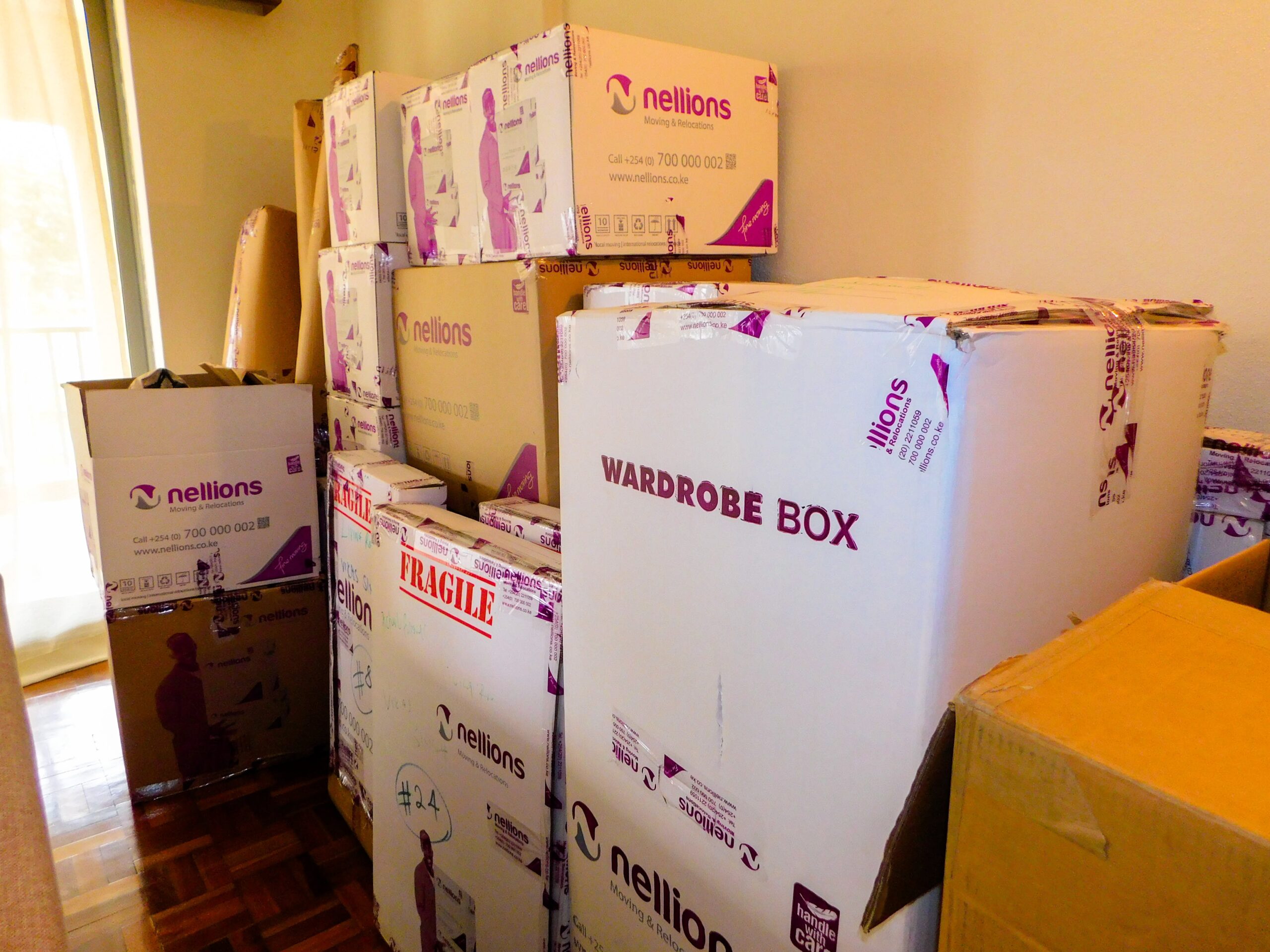
There is usually a moment when packing when it hits you, this is not just about having enough boxes. That is the part people underestimate about packing supplies it is not really about quantity, it is about matching the material to the item. Get that right, and moving day goes a lot more smoothly, whether you are relocating across Kampala, putting things into storage for a while, or packing up for a longer move.
Here is what we would recommend having on hand before moving day arrives, and more importantly what each one is actually for.
Start With the Right Box, Not Just Any Box
Boxes are the backbone of almost every move, but treating them all the same is where a lot of moves go wrong.
Large boxes
Large boxes are good for things that take up space without weighing much like clothing, bedding, curtains, shoes, toys and bigger kitchen appliances. The mistake we see most often is people filling a large box entirely with books. It looks efficient, but a box like that becomes nearly impossible to lift safely, and the bottom tends to give way before you even get it to the truck.
Small boxes
Small boxes are for the opposite problem heavier, more compact items like books, kitchen items, small household belongings, anything you want kept together as a set. It keeps things liftable and stackable instead of becoming a two-person.
Sleeping Boxes
Not everything in a wardrobe survives being folded into a standard box. Suits, formal dresses, coats, curtains. More often than not folding them into something like a large box makes them come out the other end more creased than when they went in.
A sleeping box solves this by giving you a longer and flatter space, so garments have fewer folds to fit. It’s worth using for suits, dresses, formal wear, coats, curtains and larger linen too.
Archive Boxes.
Anyone who’s moved an office knows how quickly files turn into chaos. Loose folders, receipts, contracts, and records get mixed up fast once they are rushed into whatever box is closest.
Archive boxes keep documents grouped the way they were on the shelf, which makes unpacking much easier. Files go straight from the box back into a filing system instead of getting sorted from scratch. They work well for office files, contracts, client records, financial documents, receipts and invoices, personal records, academic paperwork, and general home-office documents.
Something to remember is, if you’re moving an office, label archive boxes by department, year, or category before moving day.
Bubble Wrap
Some belongings like glasses, plates, electronics, mirrors, anything decorative and breakable genuinely should not move around at all inside a box or else, damages will be made. Bubble wrap cushions these against the knocks that happen during loading, transport, and unloading, no matter how careful everyone is. It is also advisable not to leave the box half-empty either, a perfectly wrapped item can still get damaged if it has room to slide around.
Plain Packing Paper for Kitchens
Newsprint or white packing paper looks almost too simple to matter, until you start packing a kitchen. It wraps plates, mugs, bowls, glasses, and anything else that needs a layer between it and what else is in the box.
It is useful for wrapping plates individually, separating any damaged kitchen cutlery, wrapping mugs and cups, protecting glassware, wrapping small jars and bottles, filling gaps inside a box, and adding a layer around picture frames. When stacking plates, slip a sheet between each one rather than stacking them bare and for anything especially delicate, a layer of packing paper first, then bubble wrap over it, gives you the best of both.
Corrugated Cardboard for Flat, Hard Surfaces
Some items need more structure than softness. A large mirror, a framed piece of art, furniture benefits from a firmer layer rather than just cushioning, and that is where corrugated cardboard paper comes in.
It protects mirrors, picture frames, furniture edges, table tops, and artwork and doubles as a useful layer between items being stacked on top of each other. For anything particularly delicate, pairing corrugated cardboard with bubble wrap works well, the corrugated paper gives structure, the bubble wrap adds cushioning. Packing materials rarely need to be used one at a time, combining them is usually what gives the best protection.
Microfoam (Seal Air) for Polished and Glossy Surfaces
Bubble wrap is great at cushioning, but it isn’t always the right thing to put directly against a polished or glossy surface. Microfoam gives you a thinner, smoother layer for exactly those situations. Surfaces like TV screens, polished furniture, glass, leather, marble, artwork, and other finished surfaces that mark easily.
For anything high-value or delicate, microfoam as the first layer against the surface, followed by bubble wrap on top, gives you surface protection and impact protection at the same time.
Shrink Wrap
Boxes handle most of a move, but nobody is fitting a sofa into one. Shrink wrap is what covers and contains larger items like sofas, mattresses, luggage, bed frames, dismantled furniture panels and palletised goods.
It holds tightly around a piece, protecting it from dust, dirt, and incidental moisture while it is being handled and moved, while it is also useful for keeping loose components together. If a piece of furniture has been taken apart, wrapping the matching sections together keeps them from getting separated en-route. It is worth remembering that shrink wrap is not a substitute for cushioning where something is genuinely fragile. Think of it as the outer layer that secures, not the layer that protects against impact.
Strong Tape
You can have the right boxes and carefully wrapped belongings, and none of it matters if a carton opens mid-move. A reliable packing tape, like clear BOPP tape, seals and reinforces the top and bottom of moving boxes, secures wrapping, holds bubble wrap in place, and secures anything headed into storage or shipping.
Pay particular attention to the base of every box before you put anything in it. Heavy items put far more pressure on the bottom of a box than most people expect, and it is a lot easier to run another strip of tape across the bottom now than to deal with a box giving way once it’s already been picked up.
Need Packing Materials in Kampala?
If you have got a move coming up, Nellions Shop carries the materials covered here, moving boxes, archive boxes, bubble wrap, newsprint packing paper, corrugated cardboard, shrink wrap, microfoam, and packing tape. Get what you need ahead of moving day, so your belongings are protected from the moment packing actually starts.